
Tree removal in Gold Hill means cutting a tree down, either in one piece where there is open ground or in sections where a house, a slope or a wire is in the way. One free call to (541) 502-8114 reaches an independent tree service with an Oregon CCB license, and only that one. Have it size up the tree, then get the price and the method from it in writing.
Tree Service Gold Hill passes calls to that company and does no tree work itself. You decide whether to hire anyone. This page walks through how to tell if removal is the right answer, the three main ways a tree comes down on Gold Hill's hillside lots, what pushes the price up or down, the city, county and state rules to check first, and how to get the yard ready. Start at the home page for how the referral works.
Is removal the right answer for your tree?
Removal makes sense when a tree is dead, structurally failing, in the wrong place for good, or a fire risk that pruning cannot fix. Many trees that look worrying can be kept with pruning or simple care, so it pays to be sure before the saw starts.
| Situation | Usually points to | Why |
|---|---|---|
| Tree is dead or most of the crown is brown | Removal | Dead wood dries, gets brittle and drops limbs without warning |
| Large crack in the trunk or a split where two stems join | Removal or an assessment first | Cracks are a classic sign of a tree that may fail |
| Fungus shelves or mushrooms at the base | An assessment first | Often a sign of decay inside the trunk or roots |
| A few dead branches in a healthy crown | Pruning | Cleaning out dead wood is a normal trim |
| Crown reaches the roof or grows close to the service wire | Pruning, or Pacific Power for its lines | Reduction cuts can pull a crown back |
| Crowded young firs under big oaks | Removal of the firs | ODF says white oaks die when Douglas-fir overtops them |
The decay and crack warnings come from the University of California's guide to recognizing hazardous trees. The oak point is from ODF's Oregon white oak profile. If you are unsure, book a tree health check before you book removal. Dead trees have their own page, dead tree removal, because they behave differently under the saw.
Three ways a tree comes down on a Gold Hill lot
The method depends on how much open, safe ground lies in the direction the tree would fall. Every method has a different crew size, gear list and price.
Felling in one piece. On acreage near Sams Valley or a wide pasture, a sawyer cuts a notch facing the open ground and a back cut behind it, and the tree drops where the notch points. It is the fastest method, but it needs open, clear ground that runs well past the tree's full height.
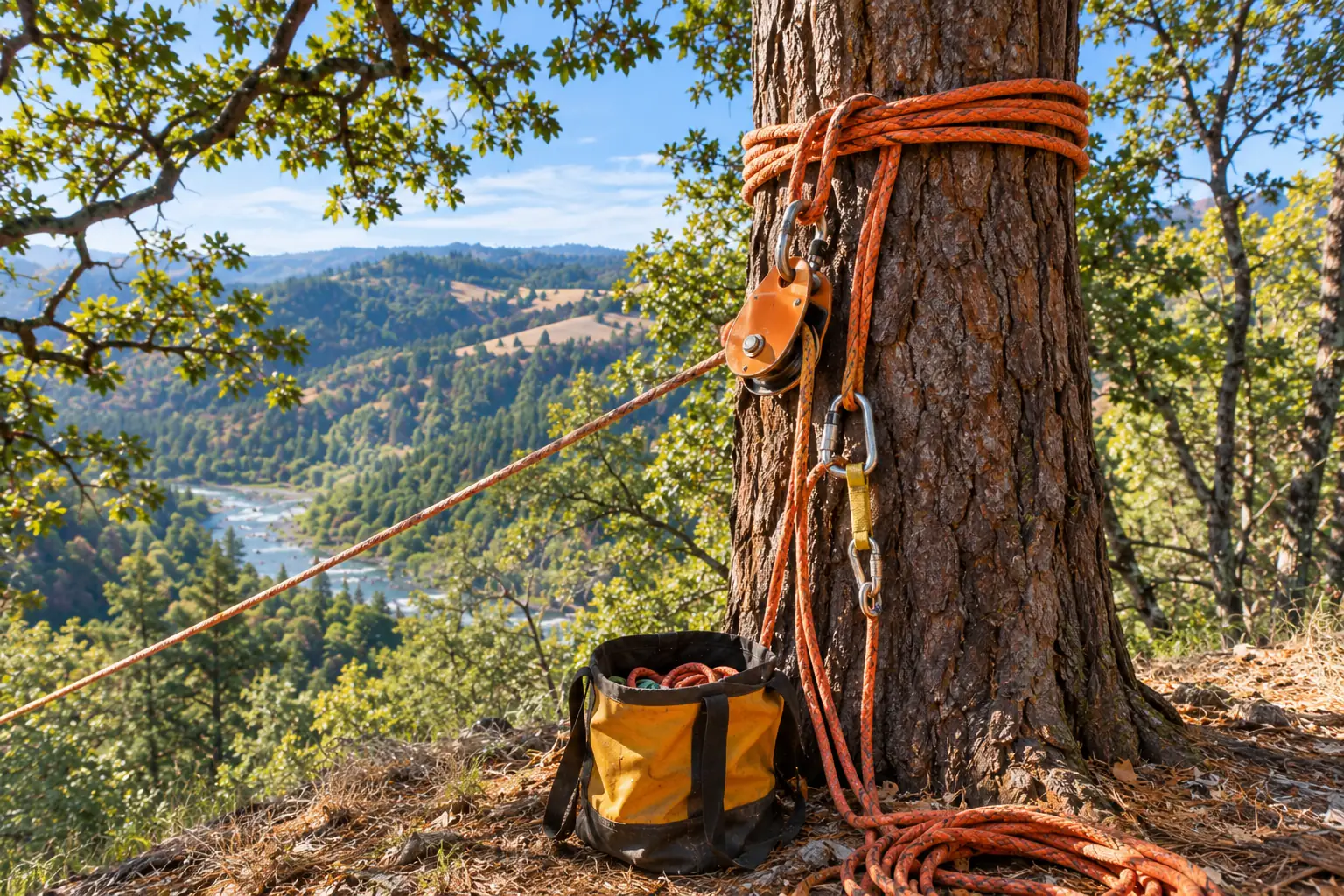
Sectional removal. Where a house, shop, fence or slope sits under the tree, a climber or a worker in a lift dismantles it starting at the crown. Branches go first, and the stem follows in short lengths. Heavy pieces are tied off and lowered on rigging rope through a block, so they land gently instead of bouncing downhill.
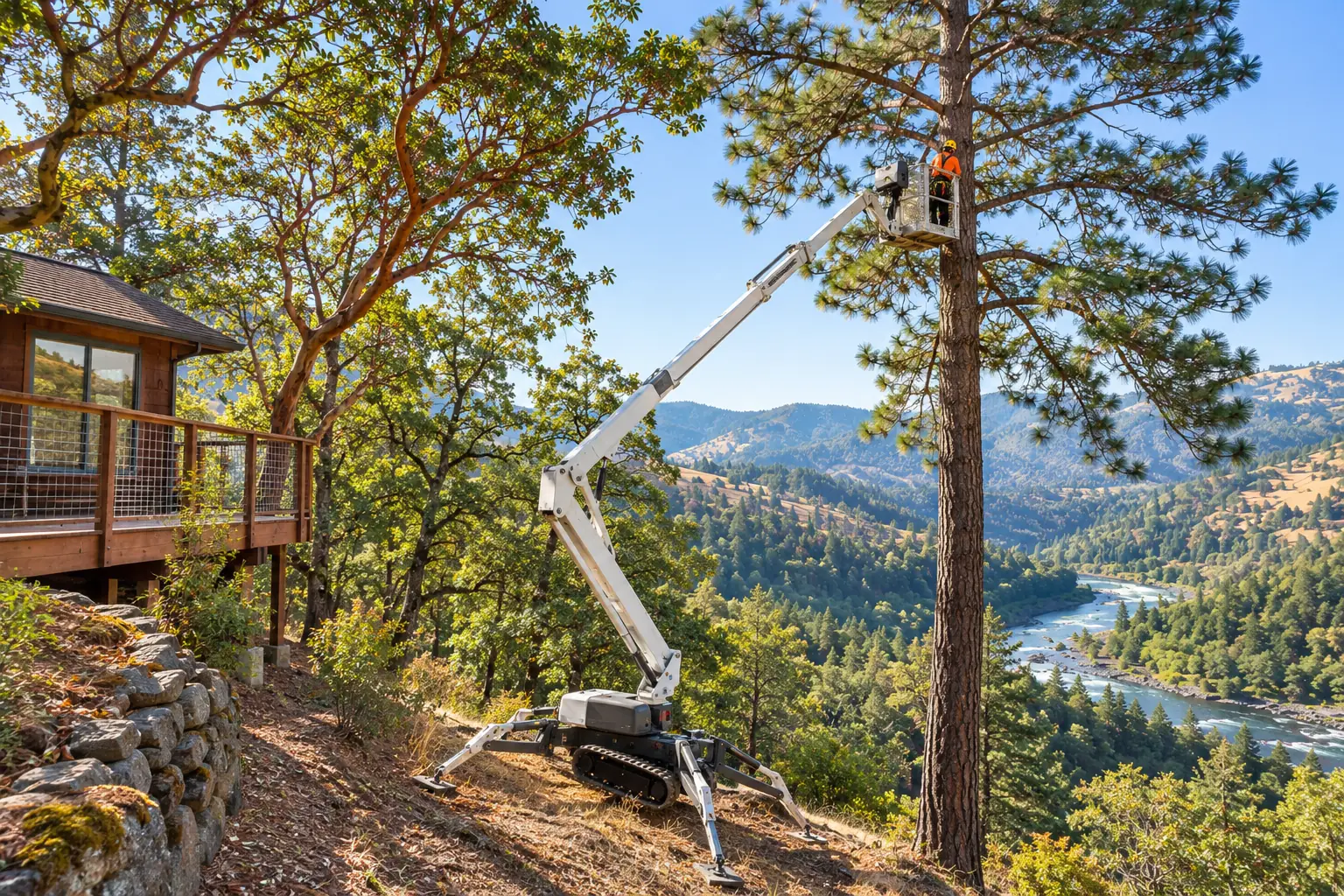
Lift or crane assisted removal. A tracked spider lift can walk up a slope or through a gate that a bucket truck cannot, then reach a tall pine from the side. For very large trees over a home, a crane can lift each cut piece clear. Cranes cost more per hour but can make a long, risky climb short.
The hillside tree work guide goes deeper on slopes, rigging and erosion after a removal.
What moves a removal quote up or down
Height is the biggest single factor, then access, what lies underneath, and the tree's condition. Lawn Love's tree removal cost guide, updated October 5, 2026, lists these national ranges:
| Tree height | National price range |
|---|---|
| Up to 30 feet | $285 to $435 |
| 30 to 60 feet | $435 to $870 |
| 60 to 80 feet | $870 to $1,160 |
| Over 80 feet | $1,160 to $2,000 |
Lawn Love puts the national average at $850. LawnStarter's removal price guide, updated the same day, gives a typical range of $385 to $1,070, or $10 to $14 per foot, with an average of $630. Neither figure is a local quote.
Around Gold Hill, these things move the number most:
- Slope and reach. A tree down a bank, where trucks cannot park, costs more labor.
- Targets. A roof, a septic system, a well head or a neighbor's shop under the tree means sectional work.
- Power lines. Work near the service drop waits on a Pacific Power disconnect.
- Fire season. Short saw hours can turn one day into several mornings.
- Cleanup. Chipping, hauling logs, leaving firewood rounds or grinding the stump are often priced as separate lines.
The company's written estimate is the real price. Ask it to spell out the method, the cleanup and whether the stump is included. The stump grinding page covers that last step, and the tree service cost guide puts all the ranges side by side.
Rules to check before a tree comes down
Gold Hill's code sections reviewed for this page do not set a general permit for cutting a tree on a private lot. Several rules still apply to certain trees and places, and they change, so confirm with the office named.
The Rogue River band. Gold Hill's zoning title, in section 17.49.040, holds plants and trees in place for 75 feet back from the river's top of bank. It allows three exceptions: replacing non-native plants with natives under a landscape plan, clearing for permitted water-related uses, and forestry approved under Oregon's forest practices law. Call City Hall at (541) 855-1525 before removing anything in that band.
Rural land outside the city. Jackson County rules apply in places like Sams Valley, Foots Creek and the Applegate. The Jackson Soil and Water Conservation District's riparian guide says the county keeps trees within 75 feet of the Rogue and 50 feet of other streams, measured from the top of the bank, unless removal is approved. Jackson County Planning answers at 541-774-6907.
Ground disturbance on slopes. If tree work is part of a project that needs a building or grading permit, Section 17.50.020 of Title 17 requires an erosion control plan when the work disturbs 2,500 square feet or more, disturbs land within 50 feet of the top of a stream or river bank, or disturbs 500 square feet or more on a slope of ten percent or steeper.
Selling logs. If logs from the job will be sold, ask the Oregon Department of Forestry whether a notification of operation is needed before work starts.
Fire season. ODF's 2026 regulated closure limits power saws to morning and evening hours at moderate and high fire danger and bans them at extreme danger, unless the State Forester approves a waiver in writing. The fire season rules guide has the full table.
Getting your yard ready for removal day
A little preparation keeps the job shorter and avoids damage. Most companies will tell you what they need, but these steps are common:
- Move cars, trailers, grills and patio furniture well out of the work area.
- Mark sprinkler heads, septic lids, buried water lines and anything fragile in the lawn.
- Tell the company where the septic tank and drain field are, so heavy equipment stays off them.
- Unlock gates and agree where trucks and the chipper will park.
- Keep children and pets indoors or away from the property while cutting is going on.
- Tell your neighbors if a tree near the line between lots is coming down.
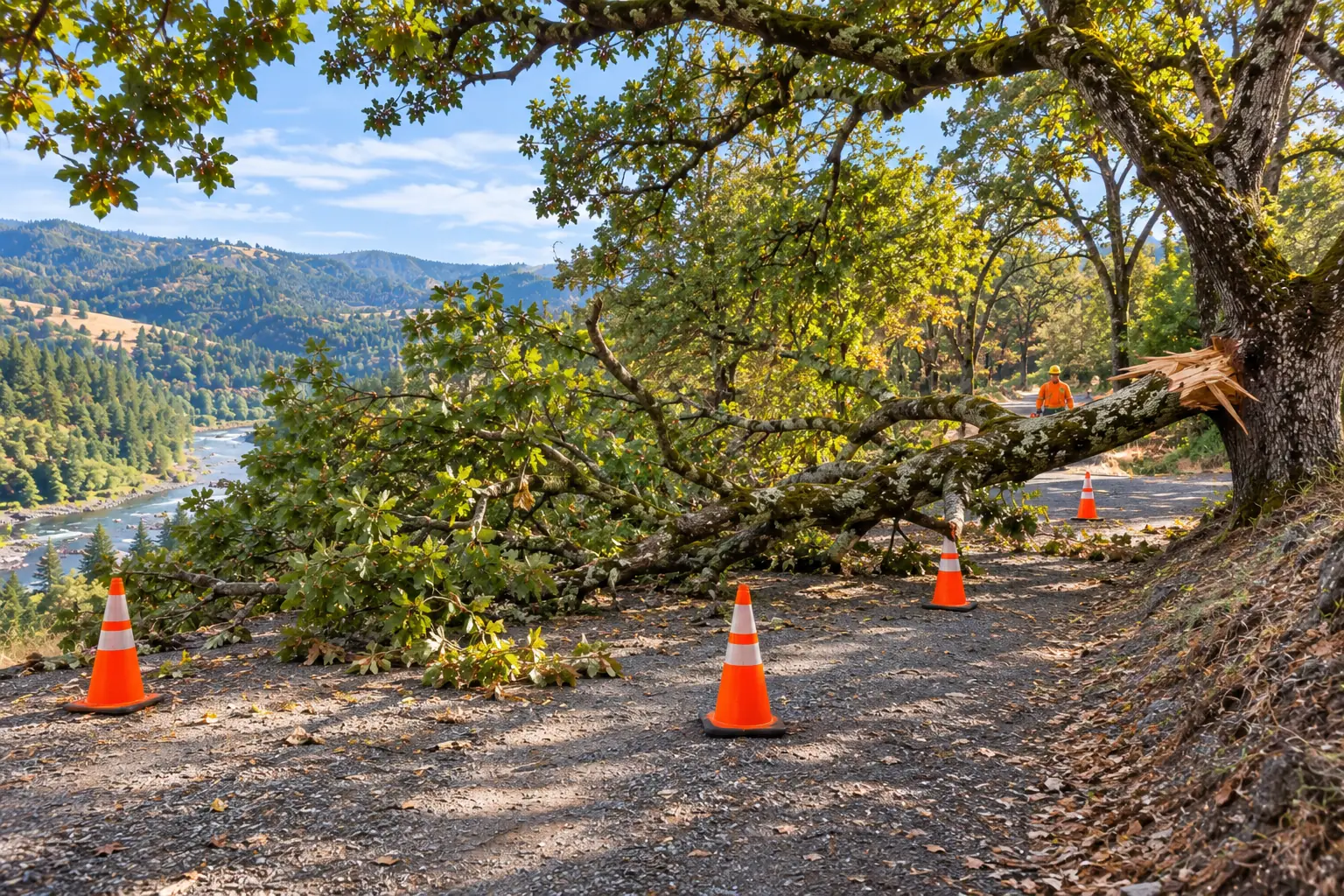
If the tree hangs above the service drop that feeds your house, call Pacific Power at 1-888-221-7070 while the job is still being planned. Its tree page says it can provide a free temporary service disconnect so licensed workers can cut safely. A tree that has come to rest on a wire is past the planning stage: clear off to 35 feet, dial 911, and give Pacific Power the report after that on 1-877-508-5088.
Questions that sort out the companies
The answers below tell you more than the total at the bottom of a quote:
- What is your CCB number? Check it on the Oregon CCB license search or call the CCB at 503-378-4621. The Landscape Contractors Board's tree work FAQ says removal and stump grinding need a CCB or LCB license.
- Do you carry liability and workers' compensation insurance, and will you send the certificate?
- Will you fell the tree whole or take it down in sections, and why?
- Are stump grinding, chipping and log hauling included, or priced separately?
- How will fire season saw hours affect the date?
- Who decides the tree has to come down, and is anyone on the crew an ISA Certified Arborist?
Get the answers in writing. A company that will not put its method and its cleanup on paper is a company to skip. More on reading estimates is on the how it works page.
Frequently asked questions
Does the city have to approve cutting down my tree?
Not as a rule. The parts of Gold Hill's code checked for this page contain no general permit for taking down a tree on private land. The 75-foot band along the Rogue is the exception, with its retention rule, so call City Hall at (541) 855-1525 before cutting there.
How long does a removal take?
A small tree on flat, open ground may be gone by lunch. A tall pine dismantled piece by piece above a roof can fill one long day or stretch into two, and fire season saw hours can split it across several mornings.
Is the stump included in the price?
Often not. Many companies quote stump grinding as a separate line. Ask for it in the same written estimate so the crew can do it on the same trip.
Can a tree be dropped in one piece on a hillside lot?
Only when there is clear, safe ground in the direction of the fall. On most hillside lots near homes, crews take trees apart in sections and lower the pieces on rope instead.
What happens to the wood?
That is up to you and the estimate. Brush is usually chipped, and the trunk can be hauled away, left as firewood rounds or stacked. Leaving wood on site often lowers the price.