
A tree health check in Gold Hill is a visit where a trained person walks around a tree, looks at the crown, trunk, roots and soil, and tells you whether it is healthy, needs care, or is a risk to people or buildings. Call (541) 502-8114 for a free referral to an independent tree service with an Oregon CCB license, and ask for an arborist's assessment.
Tree Service Gold Hill is a referral service. It does not inspect trees and does not employ arborists. The company you are connected with does the looking and may offer pruning, care or removal, which you are free to accept or turn down. Ask before the visit whether its findings come in writing and whether the check is billed. This page explains what an arborist is and how to check one, the local tree problems worth watching for, what happens during an assessment, what it costs, and what to ask. The home page explains the referral.
What an arborist is, and how to check one
An arborist is a person trained in the care of individual trees, from pruning and planting to diagnosing problems and judging whether a tree may fail. The word on its own does not tell you much, so the credential behind it is what to check.
| Credential | Who issues it | What it shows | How to check |
|---|---|---|---|
| ISA Certified Arborist | International Society of Arboriculture | Has passed an exam showing the minimum knowledge and skill for tree care work, and agrees to a code of ethics | ISA credential directory |
| Tree Risk Assessment Qualification (TRAQ) | International Society of Arboriculture | Holds ISA's qualification in assessing tree risk | ISA credential page and the directory |
| Oregon CCB license | Construction Contractors Board | The business is licensed to do tree removal and related work | CCB license search |
The ISA's Find an Arborist page says certification demonstrates that a person has the minimum knowledge and skill to perform the work. A certificate belongs to a person, not a company, so ask whether the certified arborist will be the one at your tree. Oregon's Landscape Contractors Board says on its tree work FAQ that tree removal and stump grinding need a CCB or LCB license, so check the business license too.
Warning signs that call for a health check
Book a check when a tree near a house, road or play area shows a change you cannot explain. The ISA's tree hazards page and UC IPM's hazardous tree guide list these signs:
- Dead or broken branches in the crown, or split and torn limbs.
- Cracks in the trunk or where large limbs fork.
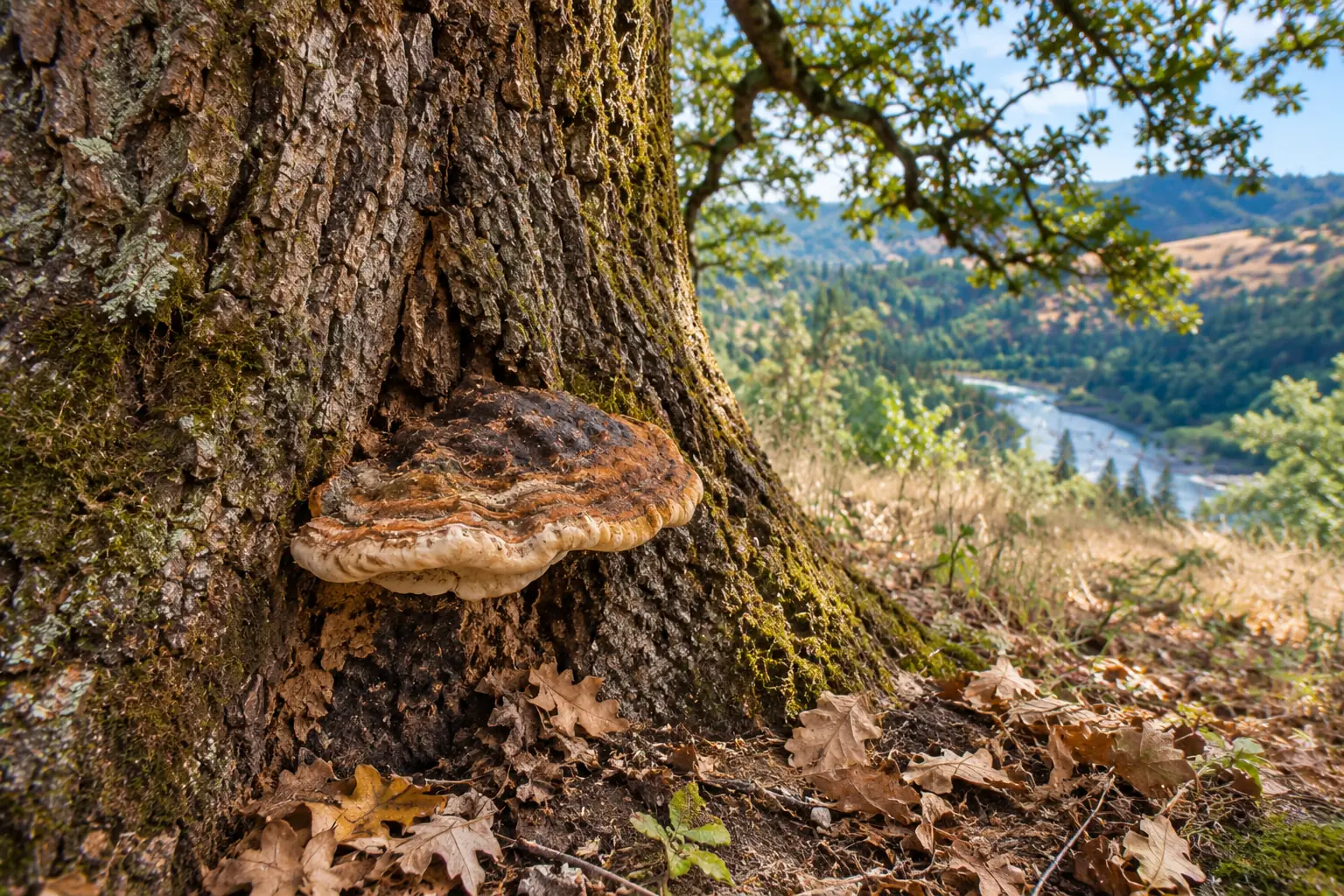
- Brackets, conks, mushrooms or other fungal growth on the bark or around the base.
- A trunk that leans, or new cracks in the soil near the base.
- Smaller and fewer leaves, dieback at the top of the crown, or fall color that comes early.
- Recent digging, trenching, added fill soil or heavy equipment in the root zone.
The ISA says severed roots, compacted soil and fill over roots can make a tree decline, and that poor drainage must be corrected or trees will decline rapidly. If a septic repair, new driveway or addition went in near a big oak in the last few years, mention it during the visit.
Local tree problems around Gold Hill
The native trees on Gold Hill's slopes have their own common troubles. Knowing them helps you describe what you see when you call.
Douglas-fir decline. OSU Extension's EM 9406 (September 2023) ties widespread fir deaths on the dry edges of the Rogue and Applegate valleys to dry sites, hotter droughts and the flatheaded fir borer. Signs include dying tops, yellowing or thinning needles, many small cones near the top, pitch droplets on the bark and woodpecker flaking. OSU says acting early gives more options at lower cost.
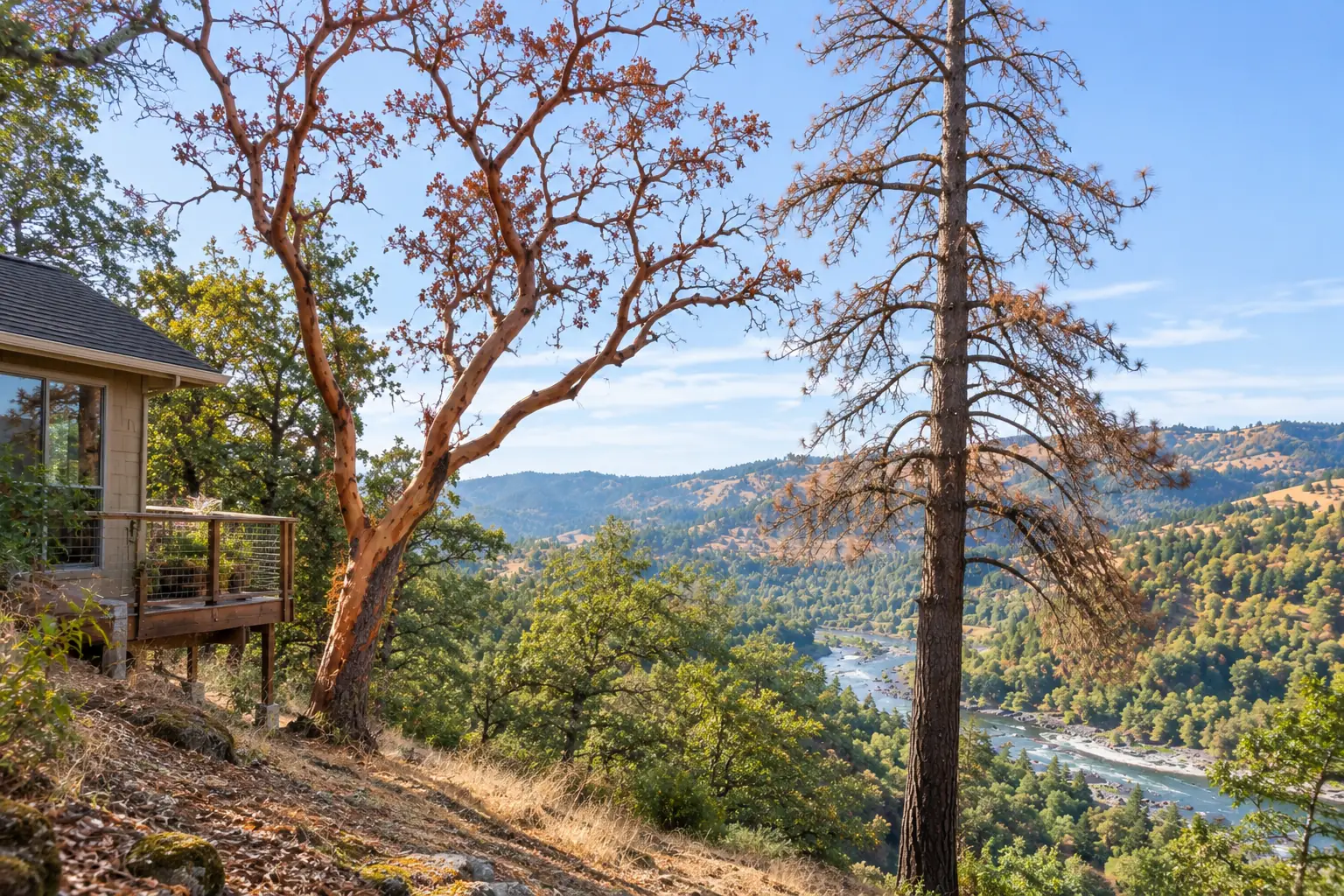
Madrone leaf disease and cankers. OSU's fact sheet EC 1619 (reviewed 2023) covers three kinds of madrone disease: foliage diseases, branch dieback and trunk cankers, and root diseases. An OSU Extension answer on troubled madrones says foliage disease seems tied to warmer winters and wet, warm springs, that many sickly-looking madrones keep living, and that there is no real cure. It adds that madrone loves full sun and can look poor in shade.
Mistletoe. OSU's EM 9679 (reviewed 2026) says true mistletoe on oaks usually has negligible effects, while dwarf mistletoe on conifers such as ponderosa pine can cause growth loss, top kill, death and more bark beetle attack.
Bark beetles in pines. ODF's slash fact sheet explains that fresh pine slash breeds Ips beetles, which can build up and attack standing trees nearby. Fading pines near recent cutting deserve a look.
The madrone and oak care guide covers everyday care for the two native broadleaf trees.
What happens during an assessment
Most residential checks are visual, done from the ground, and take less than an hour for a few trees. The person doing it will usually:
- Ask about the tree's history: storms, construction, watering, past pruning, anything that changed.
- Walk the whole circle around the tree, looking at the root flare, the soil, and the base for fungus or cracks.
- Look up through the crown for dead wood, weak forks, cracks and the density of the foliage.
- Often tap the lower trunk with a mallet, listening for a hollow sound that can point to decay inside.
- Note what the tree could hit if it or a large limb failed: the house, a driveway, a play area, a power line.
- Recommend next steps, which might be nothing, pruning, care changes, monitoring, or removal.
Some cases need more. The ISA notes that an arborist may use instruments to check for decay inside a trunk. A written report, or a formal risk assessment by someone with TRAQ, costs extra and is worth asking for if a neighbor dispute, an insurance question or a large tree over a home is involved.
What a tree health check costs
Assessment prices vary more than most tree work, because some companies fold a quick look into a free estimate and others bill by the hour. LawnStarter's arborist cost guide, updated October 9, 2026, gives these national figures:
| Service | National price (LawnStarter, Oct. 2026) |
|---|---|
| Tree health assessment or inspection | Free to $250 |
| Consultations and estimates, billed hourly | $75 to $250 per hour |
| Written arborist report or site analysis, one tree | $250 to $400 |
| Average arborist project, all types | $800 (typical $300 to $1,800) |
Ask before the visit whether the check is free with an estimate or billed separately, and whether you will get the findings in writing. The written estimate from the company is what you will actually pay. The tree service cost guide lists the other jobs that often follow a check.
Questions to ask at the health check
Use the visit to get clear, written answers:
- Is the person looking at the tree an ISA Certified Arborist, and what is the certificate number?
- What exactly is wrong with this tree, and how sure are you?
- What could it hit if it failed, and how likely is that in the next year or two?
- Can it be kept with pruning or care, and what would that involve?
- If removal is the advice, why is pruning not enough?
- Should I check it again, and when?
A good answer explains the reasoning. If the only advice is "it all has to go" with no explanation, get a second opinion. If removal turns out to be the right call, see tree removal, dead tree removal or tree trimming.
Frequently asked questions
How often should my trees be checked?
There is no fixed rule. UC IPM advises examining trees regularly and having a qualified arborist inspect trees that could cause injury or property damage if they failed. After a big storm or nearby construction is a good time.
Is a fungus on my oak a bad sign?
Often, yes. Conks, brackets and mushrooms on the trunk or at the base are listed as warning signs of decay by UC IPM. Not every fungus means the tree will fail soon, so have it looked at.
Can a tree service check my trees for free?
Some do as part of a free estimate, and others charge. LawnStarter puts a health assessment anywhere from free to $250. Ask before the visit.
What is the difference between an arborist and a tree service?
A tree service is a business that prunes and removes trees. An arborist is a person trained in tree care, and the ISA certifies arborists who pass its exam. Many tree services have one on staff, so ask.
My madrone has brown spotted leaves. Is it dying?
Not necessarily. OSU Extension says foliage disease on madrone is common in wet, warm springs and that many sickly-looking madrones keep living. A check can tell you whether there is also canker or root trouble.