Tree service in Gold Hill starts with a call to (541) 502-8114, and this referral service puts you in touch with an independent tree company that holds an Oregon CCB license. It is one company, never a list. Have it come out, look at the tree and price the pruning, removal, stump grinding or cleanup. Calling costs nothing, and hiring is your call. The onsite estimate is usually free as well on everyday work, but that is the company's to grant, so settle it while you are on the phone.
This page explains the kinds of tree work people around Gold Hill ask for, what that work tends to cost, how to vet any company before it starts a saw, and the city, county and state rules that apply on the river, on steep ground and during fire season.
What a tree service handles around Gold Hill
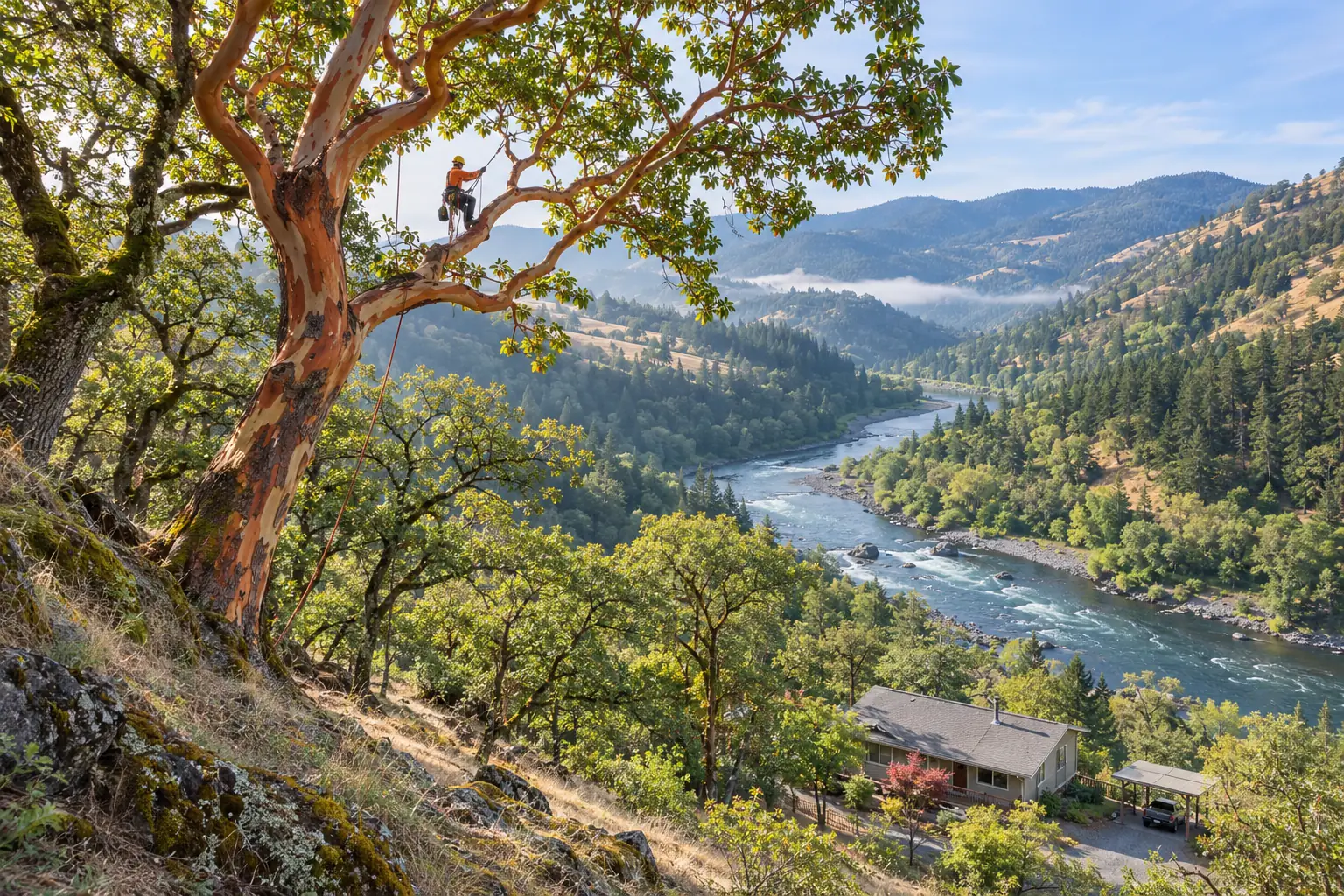
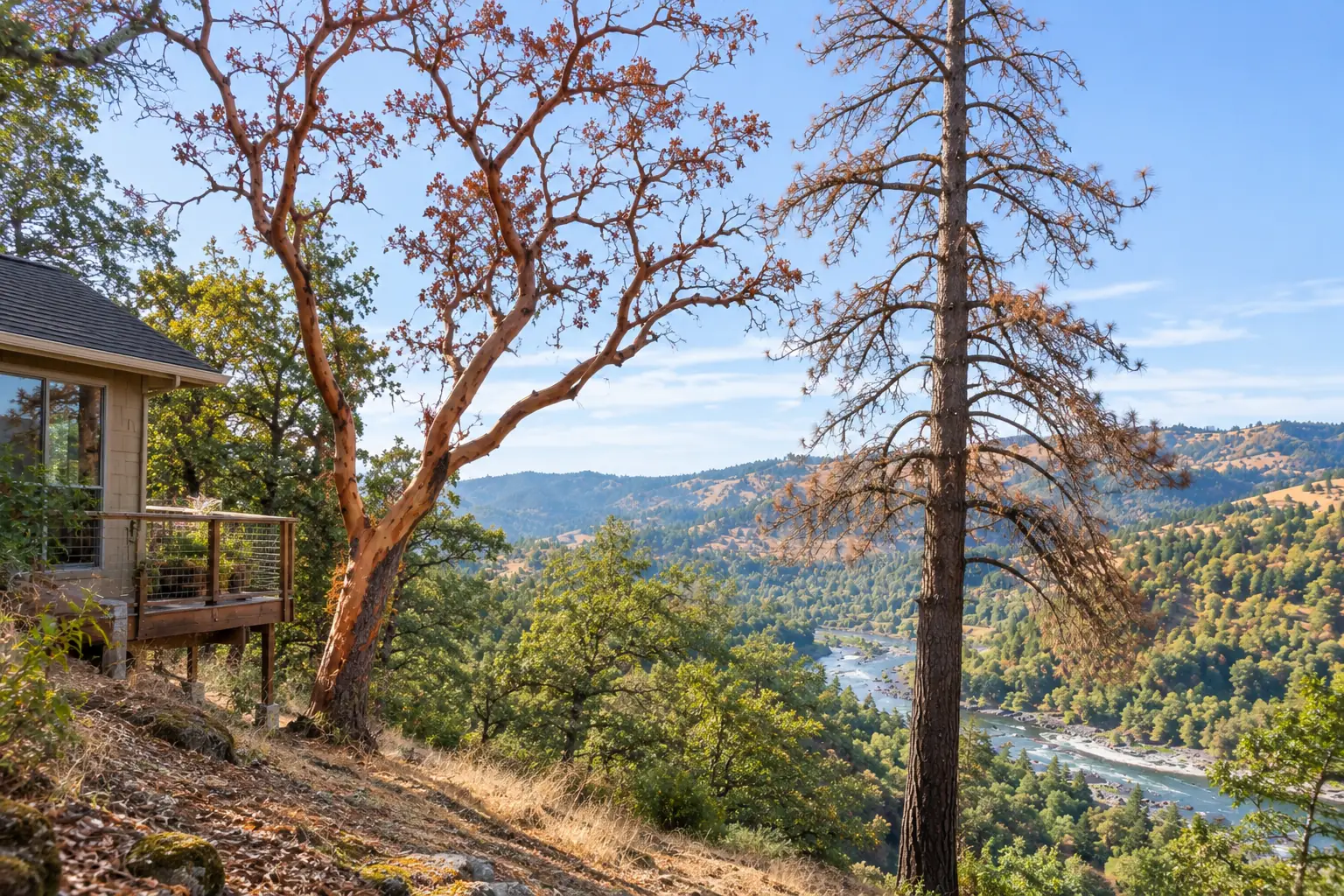
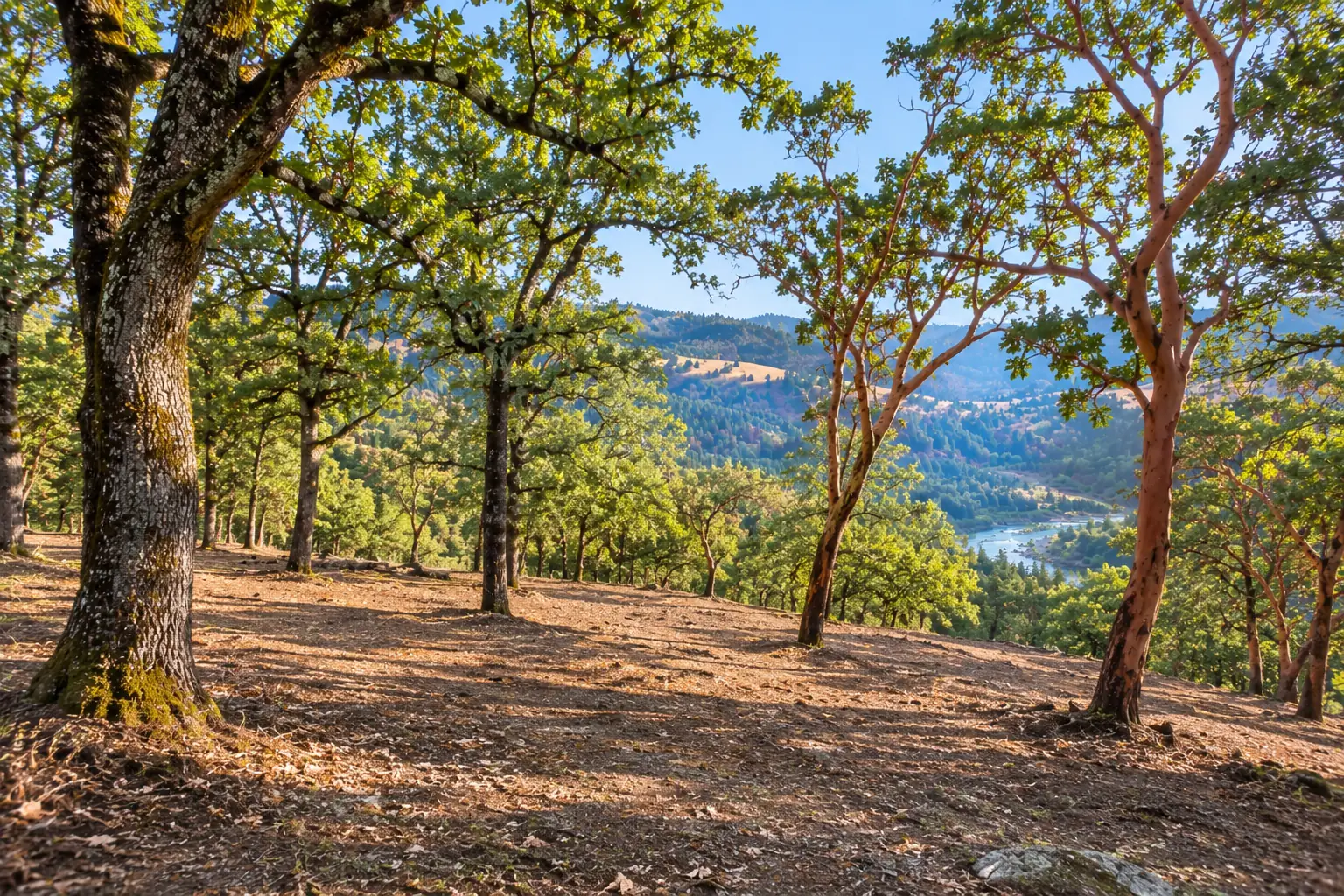
A tree service prunes, removes, grinds stumps, clears brush and checks the health of trees on homes and rural land. Around Gold Hill that work has a local flavor. Lots climb steep hillsides above the Rogue River, many yards hold madrones and native oaks, and summer brings months of fire danger that limit when saws can run.
The city itself is small. Gold Hill describes itself as a .77 square mile town seated along the Rogue River, where Interstate 5 meets Crater Lake Highway 234, with a population of 1,220 (City of Gold Hill community profile). Outside town, the work spreads across acreage in Sams Valley, ranch land along the river, and wooded parcels toward Jacksonville, Ruch and the Applegate.
Typical requests on this kind of ground include:
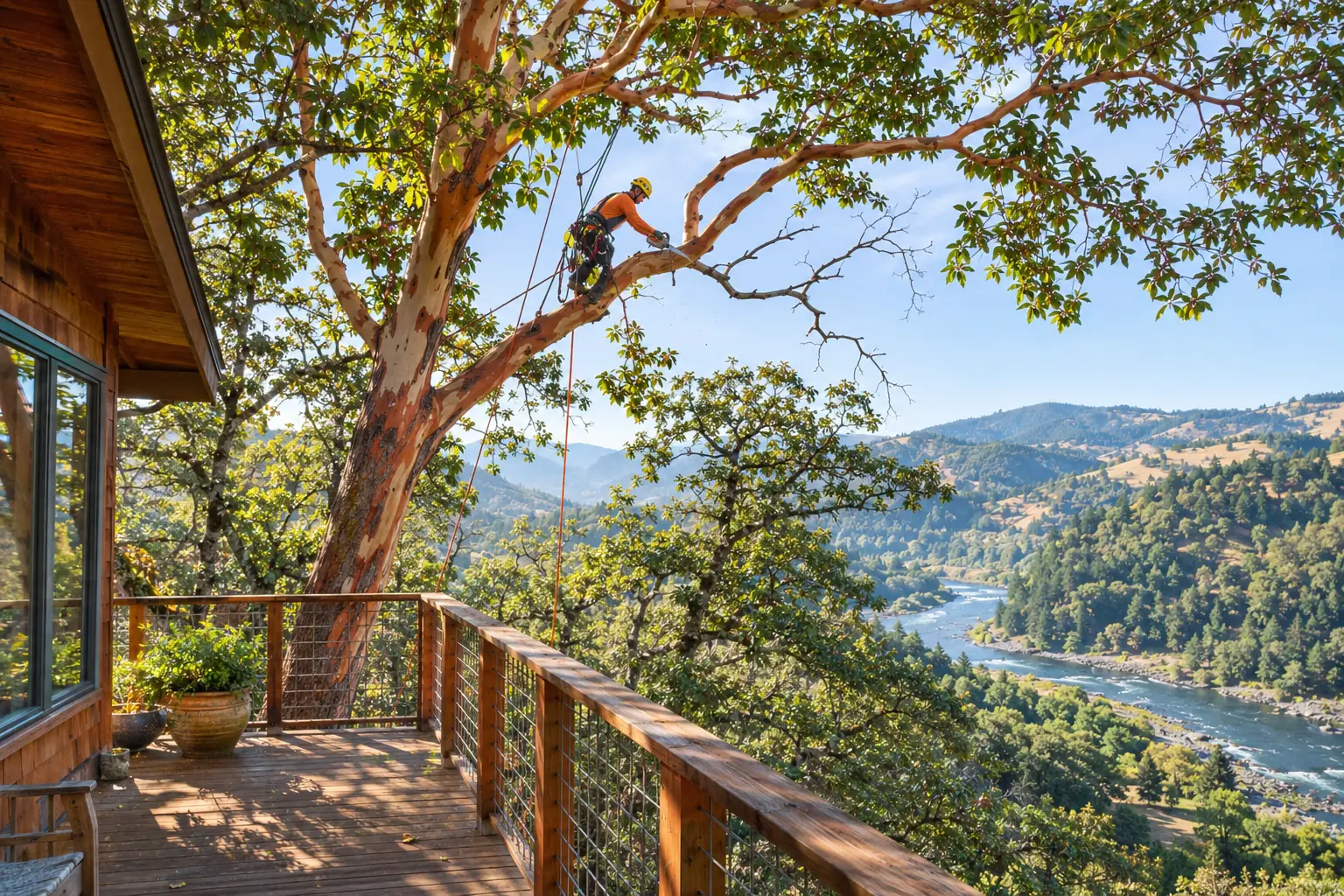
- Taking dead wood out of a madrone that hangs over a deck or roof.
- Raising the low limbs of oaks and pines so a driveway or a fire truck can get through.
- Taking down a Douglas-fir that has died on a dry slope and could reach the house.
- Grinding a stump left from a tree cut years ago.
- Clearing manzanita, blackberry and scrub from around a home or a building site.
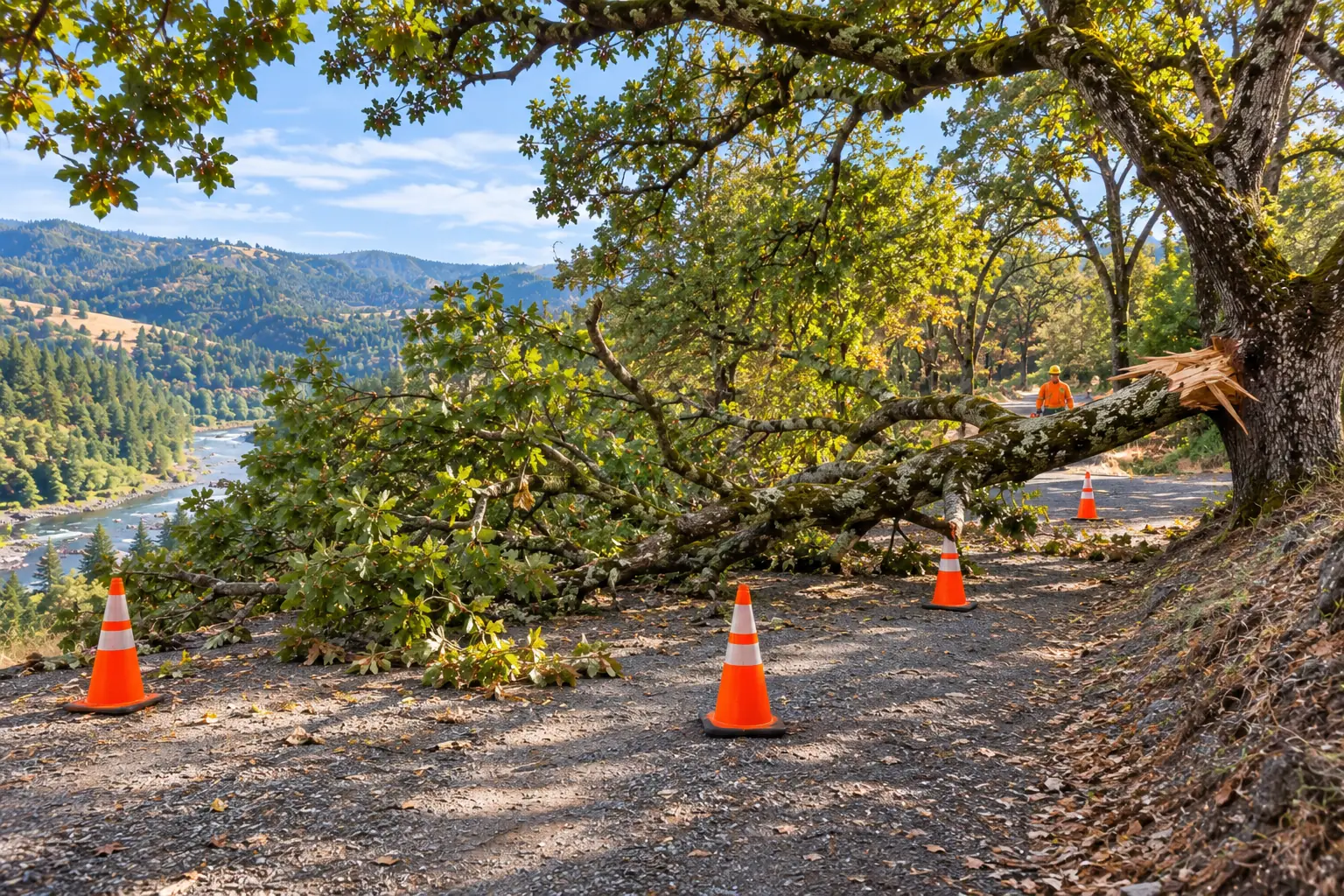
- Cutting up and hauling away a limb that came down in a winter storm.
Each of these jobs has its own page on this site, listed in the next section, so you can read what the work involves before anyone comes out.
Tree services you can ask for
Every job below can be quoted through one call to (541) 502-8114. The company you are connected with tells you on site what it can do and what it would charge.
Pruning and trimming. Pruning takes out dead, broken or crossing branches, lifts the canopy off a roof, and thins a crown so wind passes through. Done well, it keeps a tree healthy for years. The pruning and trimming page explains the cuts a good climber makes and the ones to refuse, such as topping.
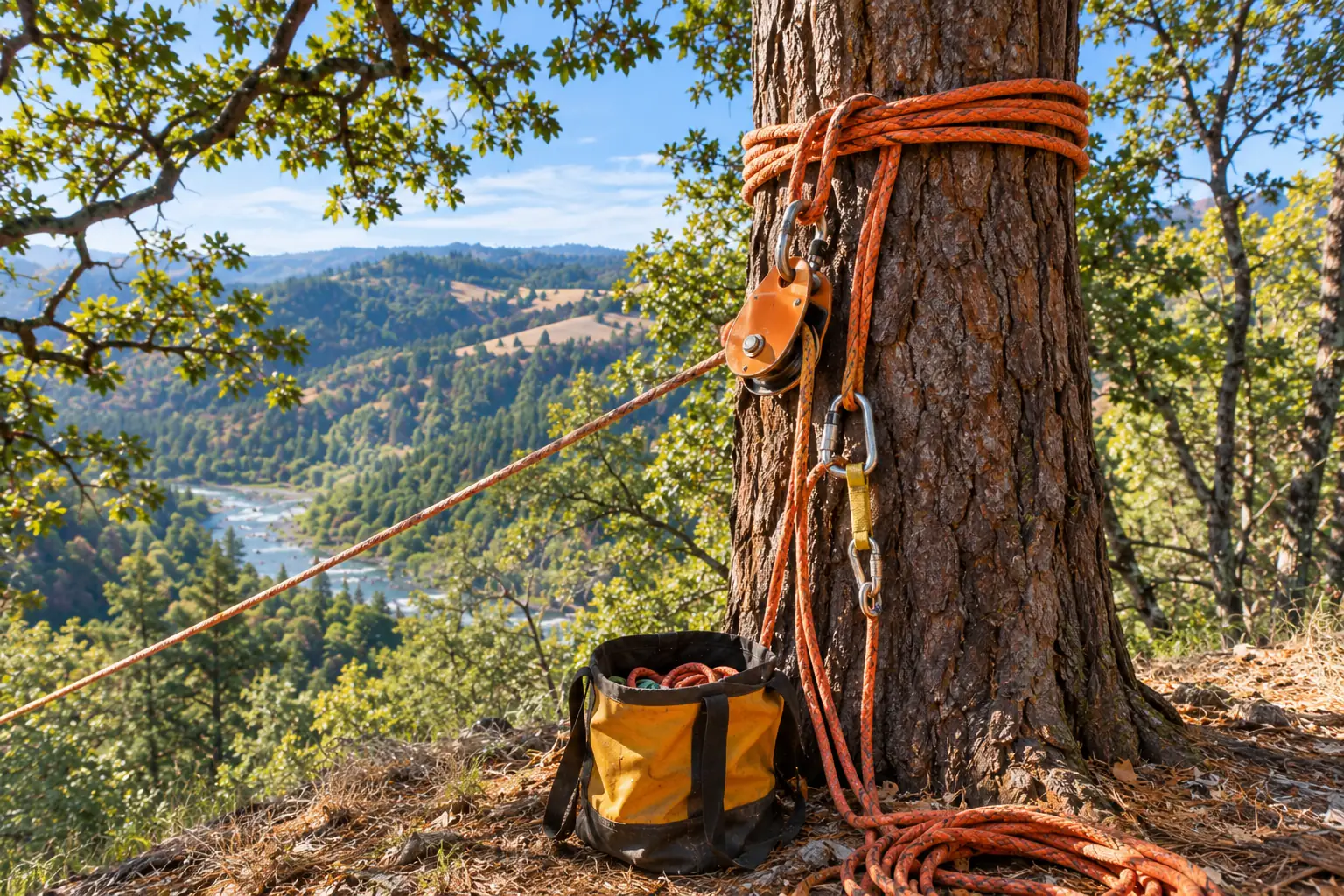
Tree removal. Some trees have to go: dead ones, trees splitting at the trunk, or trees growing into a foundation. On a steep backyard the tree usually comes down in sections lowered by rope. The tree removal page covers how a crew plans a takedown near a house.
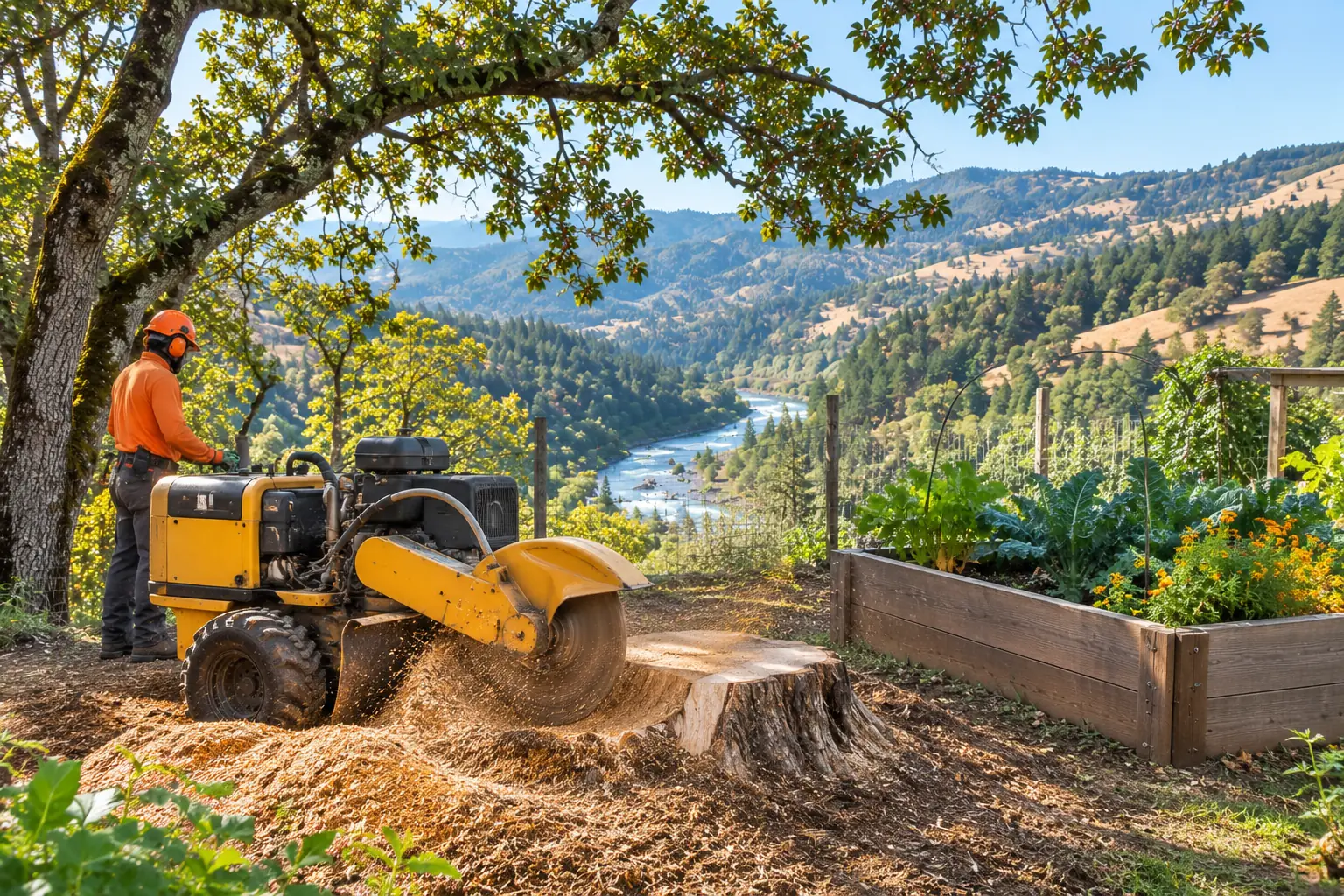
Stump grinding. A grinder chews the stump below the soil so you can plant, mow or build over the spot. It also means no more mowing around it. See the stump grinding page.
Emergency tree service. A tree on a roof, a limb hanging over a walkway or a trunk across the road needs fast attention. The emergency tree service page lists what to do in the first hour.
Dead tree removal. Dead madrones, pines and firs are common on dry slopes here, and a dead tree gets more brittle every season it stands. The dead tree removal page covers the warning signs and why dead wood is harder to rig.
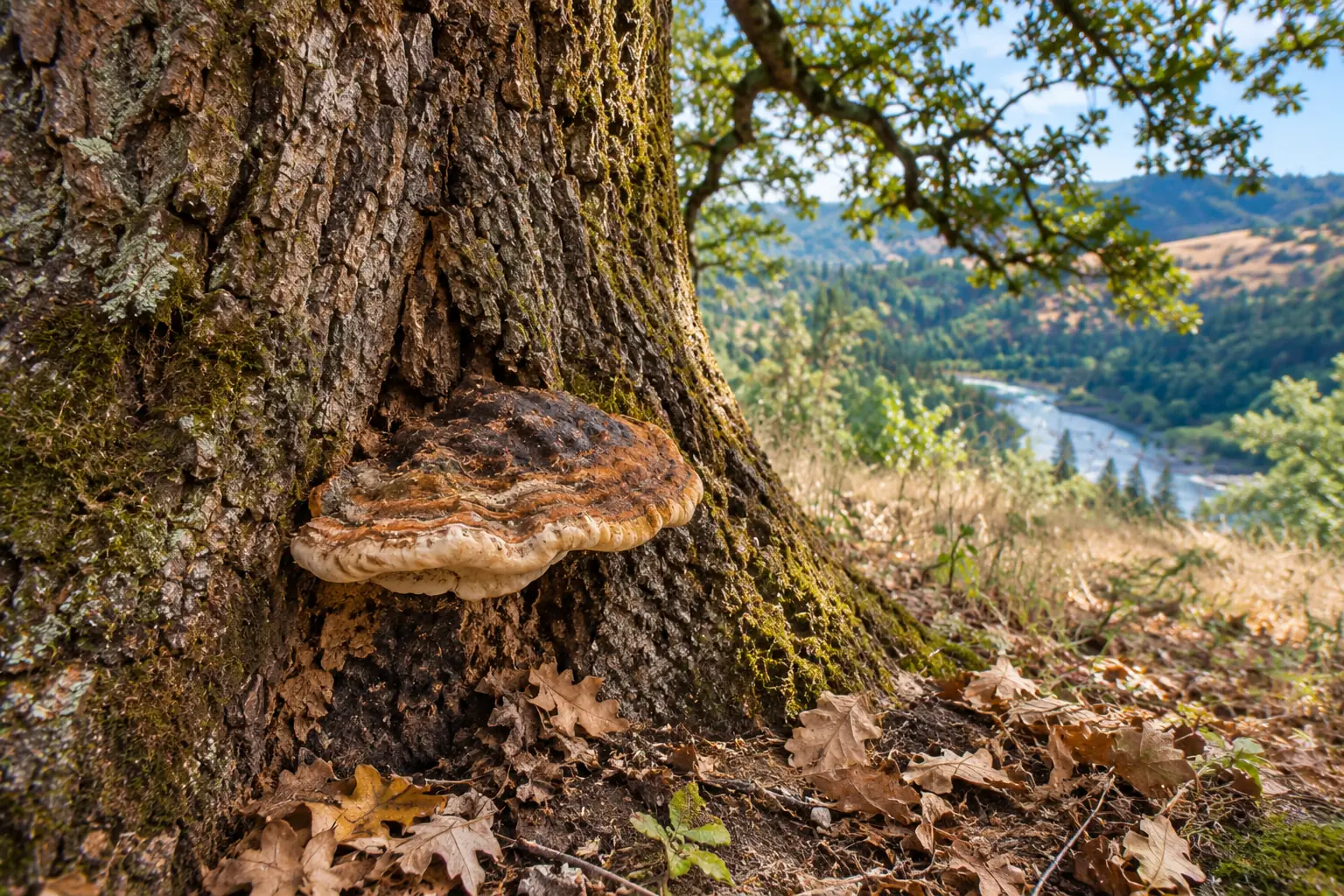
Tree health checks. A fungus shelf at the base, a thinning crown or oozing bark can mean a tree is in trouble. A health check by a trained arborist can tell you whether pruning, treatment or removal makes sense. See the tree health check page.
Lot clearing. Before building, or to open up an overgrown parcel, a crew can clear brush and small trees while keeping the oaks and madrones you want. The lot clearing page explains what changes on a slope.
Brush removal. Cutting back manzanita, poison oak and blackberry around a house is one of the most common fire season requests. The brush removal page covers chipping, hauling and what to leave for erosion control.
How one call to Tree Service Gold Hill works
This site is a referral service, so a call to (541) 502-8114 goes to an independent tree company, not to a crew employed here. Tree Service Gold Hill does no tree work. It has no saws, no trucks and no climbers, and it does not visit or price your tree.
- Call or send the form. Say where you live, what kind of tree it is if you know, and what is wrong with it. Mention anything nearby: a roof, a fence, a power line, the river.
- Your request goes to one company. A separate tree company holding an Oregon CCB license receives it and gets in touch with you.
- The company looks at the job. Have it see the tree in person, talk through the options and write its estimate down. Everyday jobs are mostly looked at without a charge, and the first call is the moment to check.
- You decide. You can say yes, say no, or get other bids first. Sending a request never commits you to hire.
You never pay this site. Its income is a referral fee from the tree company for each call or form request passed along, and that fee does not show up as a charge on your invoice. The referral disclosure page spells out the arrangement, and the how it works page goes through each step at more length.
Once you hire the company, the deal is yours and theirs alone. Tree Service Gold Hill signs nothing, sets no dates and stands behind no price or workmanship, which is one more reason to vet the company yourself as described below.
Tree service prices around Gold Hill
Expect most single-tree jobs to land somewhere from a few hundred dollars up to roughly two thousand, going by 2026 national cost surveys. Those surveys are averages from across the country. The figure that matters is the one the company writes down after walking your lot.
| Work | Low end | High end | Survey and date |
|---|---|---|---|
| Pruning, a typical tree | $430 | $640 | LawnStarter, Sept. 24, 2026 |
| Pruning, a small tree under 30 ft | $85 | $415 | LawnStarter, Sept. 24, 2026 |
| Pruning, a tall tree over 60 ft | $475 | $1,835 | LawnStarter, Sept. 24, 2026 |
| Taking down a typical tree | $385 | $1,070 | Lawn Love, Oct. 5, 2026 |
| Taking down a tree over 80 ft | $1,160 | $2,000 | Lawn Love, Oct. 5, 2026 |
| Urgent removal after damage | $450 | $3,000 | Lawn Love, Oct. 5, 2026 |
| Grinding a stump | $131 | $438 | LawnStarter, Oct. 5, 2026 |
Lawn Love's overall average for one removal is $850. For stumps, LawnStarter's average job is $272, many grinders price by width at $2 to $5 an inch, and a minimum charge near $100 is common.
Ground drives local prices more than anything. A tree on a steep pitch may have to be climbed, cut in pieces and lowered on ropes, which means more hands and more hours than a straight fell in a flat pasture. A narrow gravel drive can keep a chipper or lift out of reach. Hot summer days can shorten saw hours, so a job may stretch over several early mornings. Hauling everything off rural acreage also adds up.
A few honest ways to keep the cost down:
- Have several trees done on one visit instead of booking them one at a time.
- Keep the rounds for firewood and skip the haul-away charge.
- Book routine pruning in the slow months instead of right after a storm.
- Collect two written bids on any large job and compare line by line.
For the price factors in more depth and what a fair estimate should spell out, read the Gold Hill tree service cost guide.
Arborists, explained
An arborist is someone trained to care for individual trees, and in Oregon the word alone is not a license. When people say "certified," they usually mean ISA Certified Arborist, a credential from the International Society of Arboriculture that takes a passed exam plus ongoing education. The ISA's find an arborist search shows whether a given person holds it.
A tree that may fail calls for a second credential. The ISA Tree Risk Assessment Qualification, known as TRAQ, covers judging how likely a tree is to break and what it would land on. Before keeping or felling a big leaning oak above the house, it is fair to ask for someone who holds it.
Oregon law requires neither credential for tree work, and many skilled climbers have neither. The law does require a contractor license, covered next. It is still reasonable to ask who on the crew holds ISA certification, and whether pruning follows accepted standards with no topping.
Vetting a tree company
Three checks cover most of the risk: a valid Oregon Construction Contractors Board license, proof of insurance, and the entire job described on paper. The CCB names tree servicing as work that needs a license (CCB licensing page).
- License. Get the CCB number and type it into the Oregon CCB license search. The record should read active, under the same business name that appears on the estimate. The CCB takes calls at 503-378-4621.
- Insurance. Request a certificate. Minimums depend on the license type. On the same CCB page, a residential specialty contractor must carry a $20,000 bond and liability coverage of $300,000 per occurrence or more.
- Injury coverage. Falls and saw cuts happen in this trade. Find out whether crew members are employees covered by workers' compensation.
- Paperwork. The estimate should list every tree, what will be done to each, the price, the stump, where the wood and brush go, and cleanup.
- A second opinion. On a large job, a second bid is normal, and a solid company will not mind.
Walk away from storm chasers who knock and ask for cash first, from anyone offering to top a tree, from climbers who want spurs on a tree that is only being pruned, and from anyone who cannot produce a license number. If a finished job goes wrong, put the problem to the company in writing first. The complaints page lists the next places to turn.
Urgent tree problems
A tree problem is urgent when a trunk or big limb has struck a structure, car or fence, cut off access, or is broken and tipping toward a home or people. For those, call (541) 502-8114 and open with the word emergency.
Other problems feel pressing but can be booked like any visit: a lean that has not changed in years, an old stump, fire season brush, or storm debris lying in an open field. Schedule those and skip rush pricing.
With a tree on a wire, touch nothing: not the tree, not the wire, not whatever the wire is resting on. Back off until 35 feet separate you from all of it, and dial 911. After that, Pacific Power wants downed wires and outages reported at 1-877-508-5088 (Pacific Power safety page), and no tree company may start until the utility clears it. Photos for insurance, and what to move or leave, are covered on the emergency tree service page.
What Gold Hill's city code says about trees
The city's code sets clearance heights for branches over public ways, makes dangerous dead trees the owner's problem, and freezes vegetation in a strip along the Rogue. Below is a plain summary of the posted code. City Hall takes questions at (541) 855-1525, and planning contacts are on the city planning page.
| Topic | Code section | What it says, in short |
|---|---|---|
| Overhang above sidewalks | 8.08.100 | Leave 8 feet of open space under branches |
| Overhang above streets | 8.08.100 | Leave 13 feet 6 inches under branches |
| Planting strips | 8.08.100 | The neighboring owner or occupant looks after growth in the strip |
| Dead trees | 8.08.100 | No dead or decaying tree may stand where it endangers the public or nearby people or property |
| Open burning | 8.12.030 | No bonfires or rubbish fires on any property in town while state fire season is on |
| Yard debris | 8.18 | Tree parts, prunings and stumps may not be dumped on city or public land; fines are $500 per offense |
The table condenses Title 8 of the municipal code, the health and safety title. Street clearance is one of the most common reasons people in town book a trim.
Along the river. Title 17, Chapter 17.49, says plants and tree cover are to stay in place across a 75-foot band measured back from the top of the Rogue's bank (Title 17 zoning code). Exceptions are narrow: replacing non-native plants with native trees and shrubs under a landscape plan, limited clearing for river uses like docks and landings, and forestry under the state Forest Practices Act. The city works with Oregon's fish and wildlife agency to fix where the bank top is, so ask where that line falls on your lot before anything near the water is cut.
Hillsides and soil. Under 17.50.020, a building or grading permit needs an erosion and sediment plan if it disturbs native plants within 50 feet of a river, stream or wetland, or 500 square feet or more of ground pitched at ten percent or steeper. Ordinary pruning is not grading, though clearing a slope for a new home may trigger the plan.
The posted code shows no general permit for pruning or taking out a healthy tree in a private yard well back from the river. Codes do get amended, so call City Hall before a large job.
County land beyond the city
Outside town, Jackson County's Land Development Ordinance holds a 75-foot strip along the Rogue and a 50-foot strip along Class 1 and 2 streams and other waters with fish, leaving out farm ponds that people dug (county Land Development Ordinance, Chapter 8, section 8.6.4).
The county's way out of the strip looks much like the city's: swapping non-native plants for natives under an ODFW-approved landscape plan, clearing tied to water-dependent uses, and timber work holding a Forest Practices Act permit. One line matters for fire work. The county's fuelbreak standard does not reach inside that strip, so understory and canopy there stay put even when you are clearing for fire.
For any cutting near a creek or the river on county ground, call Jackson County planning at (541) 774-6907 first, and get the answer in writing if you can.
Fire season, fire danger and saw hours
Through the dry months, the Oregon Department of Forestry restricts when saws and other spark sources may run on the land it protects and on forestland close by, and the allowed hours shift with each day's fire danger. In 2026 the Southwest Oregon District opened fire season May 15 at one minute past midnight, covering 1.8 million protected acres across Jackson and Josephine counties (Jackson County Fire District 3, May 2026). Fire District 3 is the fire agency for Gold Hill, Sams Valley and Central Point, among others (Fire District 3).
The district's 2026 regulated closure, signed May 12, 2026 (ODF closure order), ties chainsaw use to the color of the day:
| Day's danger color | When a chainsaw may run |
|---|---|
| Green, low | Any hour |
| Blue, moderate | Until 1 p.m., then again after 8 p.m. |
| Yellow, high | Until 10 a.m., then again after 8 p.m. |
| Red, extreme | Not at all |
Every saw must have a shovel and an extinguisher of eight ounces or more close at hand, plus a one-hour fire watch once cutting stops. Battery and plug-in saws count too. Backyard debris fires are off limits for the whole season. The order reaches land the district protects and forestland within an eighth of a mile.
Commercial forest work falls under a separate scale, the Industrial Fire Precaution Levels. At level II, saws away from loading sites may run only from 8 p.m. to 1 p.m., and level IV shuts all operations down (ODF IFPL sheet). On a timbered parcel, ask the company which set of rules governs your job.
Burning has rules even after the season closes. When the 2025 season wrapped up on October 14 that year, 135 days in, Fire District 3 told residents to check on local permits and to call the county's burn information number, (541) 776-7007, for that day's status (Fire District 3 notice). The fire season tree work rules guide explains how to plan pruning and removals around all of this.
Defensible space is the other half of summer tree work. The Oregon State Fire Marshal divides the ground around a house into zones:
| Zone | Distance from the house |
|---|---|
| Immediate | Within 5 ft |
| Intermediate | From 5 out to 30 ft |
| Extended | From 30 out past 100 ft |
For trees, the Fire Marshal's advice is a 10-foot gap or more between crowns, limbs cleared to 6 feet above the ground, and no brush left growing beneath. Much of the limbing and brush cutting done around Gold Hill each summer follows that pattern.
Madrones, oaks and firs on local lots
Most calls here involve four kinds of tree: Pacific madrone, native oak, pine and Douglas-fir. Each needs its own handling.
Pacific madrone. According to OSU Extension, madrone is native only to the Pacific Coast, from northern California up to southern British Columbia, and it often does well on dry, rocky slopes that other trees cannot handle. It reacts badly to root disturbance. An established madrone wants little summer water, given rarely and deeply if at all. It drops bark and leaves for months each summer, and the winter leaf blight that blackens its foliage is usually cosmetic (OSU Extension, October 2023). So keep trenching, grading and sprinklers off its roots, and treat summer peeling as normal.
Oaks. OSU Extension counts the Rogue Valley as Oregon white oak country, mostly below about 3,800 feet and often on exposed, dry or rocky ground. California black oak's range runs south through the valleys west of the Cascades, and the tree does poorly in soil that stays wet (OSU Extension EM 9425, April 2024). A sound old oak usually deserves careful pruning rather than the saw, unless the trunk or root plate is giving way.
Douglas-fir on dry sites. Firs have been dying on hot, dry ground throughout the region. Aerial surveys cited by OSU Extension put the toll near 260,000 trees on close to 150,000 acres, spread over Jackson, Josephine and Douglas counties between 2016 and 2019, with the flatheaded fir borer as the chief insect (OSU Extension EM 9406, September 2023). Sites below 3,500 feet with under 35 inches of yearly rain carry the highest risk, as do steep slopes facing south and west. A fir the borer has taken hold of, or one whose crown is far gone, cannot be saved in OSU's view, and bark flaked off by woodpeckers signals the end is near.
Pruning timing and root care for the native hillside trees are in the madrone and oak care guide.
Steep lots and the river
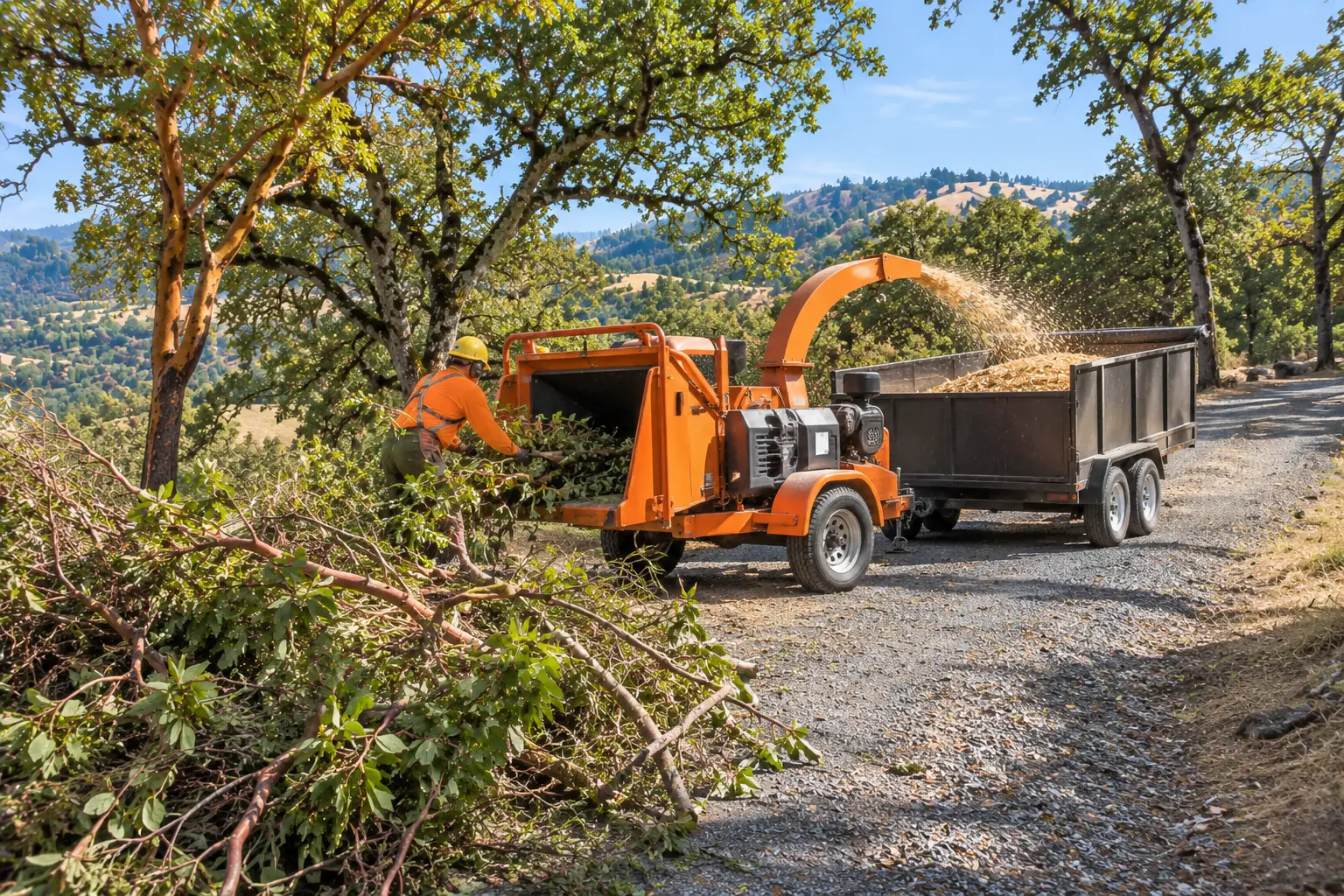
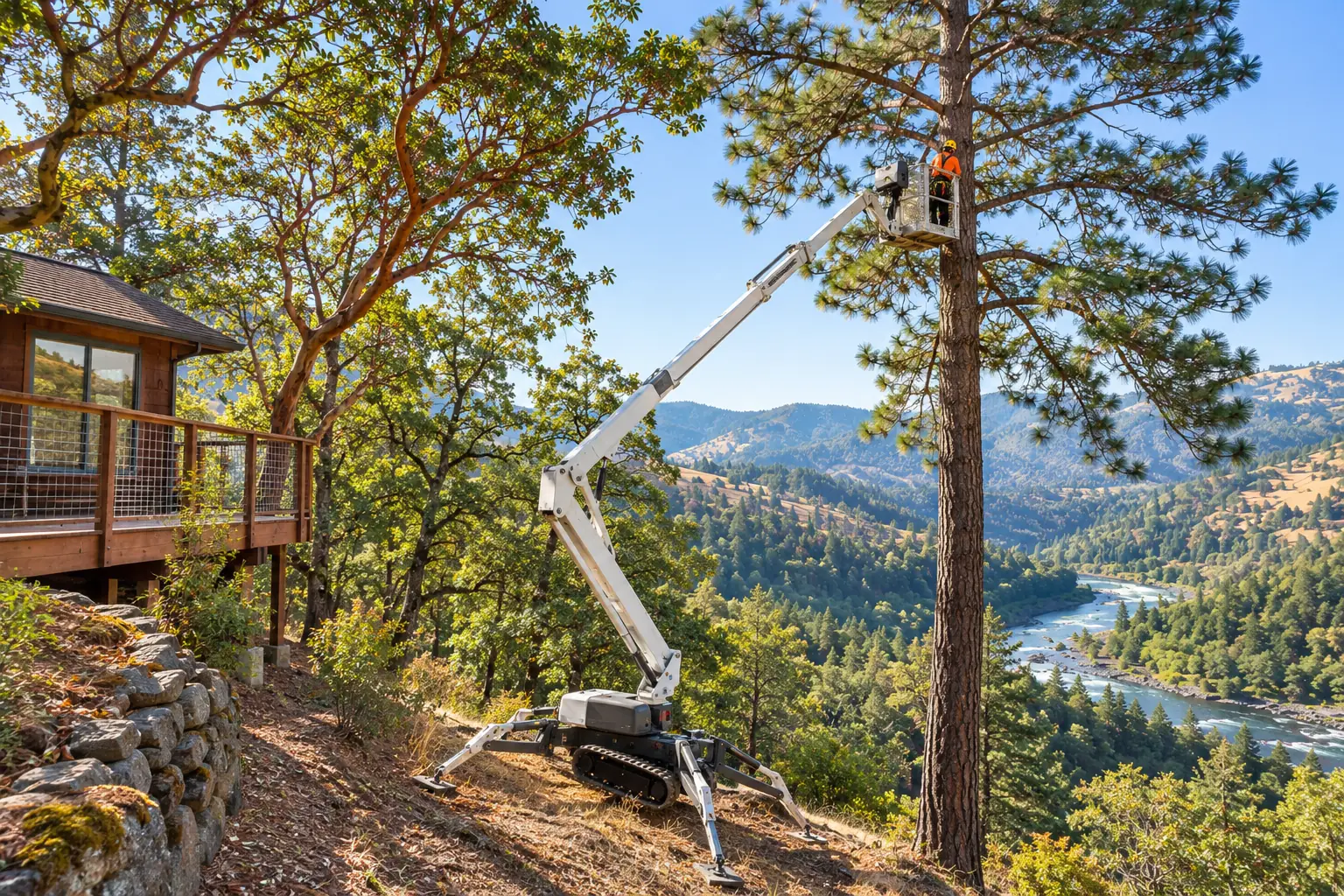
Steep ground changes how almost every tree job is done. A bucket truck often cannot set up on a slope, so the climber ropes in and lowers pieces, or a tracked spider lift is walked in on narrow tracks. Brush and logs have to be carried or winched uphill to a chipper. And when trees and roots come off a bank, the soil they held can start to move in the next rain.
Ask any company working on a slope how it will reach the tree, where it will put the chipper, whether it plans to leave stumps in place to hold the bank, and how it will keep sawdust and debris out of the river or a creek. On riverfront lots, settle the setback question with the city or county before anyone cuts. The hillside tree work guide goes through access, rigging and erosion in more detail.
Wires, poles and Pacific Power
Leave any tree growing close to a power line to the utility. Pacific Power trims around its distribution lines for free, and its number for routine tree questions, where you can ask to speak with a utility arborist, is 1-888-221-7070 (Pacific Power vegetation page). That number is for planning ahead. A tree or limb that has reached the wire itself is another matter, the 911 kind covered under urgent tree problems above, with the utility's 1-877-508-5088 as the follow-up call.
That page adds a few useful points. The utility will disconnect the service drop to your house for free, temporarily, so tree work beside it can be done safely. In areas at high wildfire risk it asks for an owner's written okay before felling a hazard tree, though it may go ahead without one for public safety if the owner cannot be found. Once its own arborist has looked at a tree, you may hire a private arborist for landscape work.
Planting new trees near a pole? Pacific Power's spacing advice:
| Tree's size when grown | Keep it this far from the pole |
|---|---|
| Small, under 20 ft | 20 ft |
| Medium, 20 to 40 ft | 40 ft |
| Large, over 40 ft | 60 ft |
Dial 811 two days or more before you dig, so buried utilities get marked.
Towns covered from Gold Hill
One call to (541) 502-8114 covers Gold Hill and the nearby communities of the middle Rogue and the Applegate side. Each town has its own page with the rules and conditions that apply there.
- Sams Valley. Open rural land north of the river along Highway 234, with oak woodland and pasture. County rules apply.
- Foots Creek. Rural ground west of Gold Hill on the south side of the Rogue, where creek setbacks and slopes often shape the job.
- Jacksonville. Its own city with its own development code, so check with Jacksonville City Hall before removing a tree there.
- Ruch. Wooded rural parcels in the Applegate Valley southwest of Jacksonville.
- Applegate. Rural homes along the Applegate River, where access and creek setbacks often decide how a job is done.
- Central Point. A larger city on the valley floor, inside Fire District 3, with its own city code to check before a removal.
Close to these towns but not listed? Call anyway, and the company will say whether it can reach your place.
Guides for Gold Hill tree owners
The guides on this site go deeper on the questions that come up most often here: what the work costs, how fire season limits saw use, how to care for madrones and oaks, and what changes on a steep lot.
Frequently asked questions
Is Tree Service Gold Hill a tree company?
No. It is a referral service that puts you in touch with an independent tree company licensed by the Oregon CCB. That company handles the estimate and every bit of the work, while this site cuts, prunes and hauls nothing.
What will I pay to use this service?
Nothing at all. Calling and sending the form are free, and you need not hire anyone. The site is funded by a fee the tree company pays, explained on the referral disclosure page.
Will the city want a permit before I prune or take down a tree?
Not usually for a healthy tree in a private yard well away from the river, going by the code the city has posted. Trees inside the 75-foot band along the Rogue are protected, though, and branches over streets and sidewalks have clearance heights to meet. Call City Hall at (541) 855-1525 to be sure about your lot.
Is summer tree work allowed?
It is, inside ODF's limits. The 2026 closure lets saws run any hour on green days, in morning and evening windows on blue and yellow days, and never on red days. The crew needs a shovel and extinguisher on hand and a one-hour fire watch after the last cut.
How can I confirm a contractor's license?
Get its CCB number, then search it on the Oregon CCB site. You want an active record under the same business name. Ask for an insurance certificate as well.
A tree landed on a power line. What now?
Keep 35 feet back or more and assume the wire is energized. Dial 911, and when that is done report it to Pacific Power at 1-877-508-5088. Tree crews have to wait for the utility to make it safe.
Is there any saving a dying Douglas-fir?
Usually not. In OSU Extension's view, a fir that flatheaded fir borers have taken hold of, or one whose crown is far gone, will not recover. Have a company judge whether it could hit a house, road or fence, then decide.